前言 这里主要说两种方式来连接MySQL。
小型项目可以直接用JdbcTemplate。
大型项目可以考虑集成Mybatis。
还有一个JPA的方式
https://www.psvmc.cn/article/2024-01-16-spring-jpa.html
Spring Data JPA 是基于 Hibernate 的,所有优缺点也很明显。
优点
缺点
版本匹配 Spring Boot最新的版本报错
降低版本就可以了
https://www.psvmc.cn/article/2024-01-15-idea-jdk-version.html
添加依赖 1 2 3 4 5 6 7 8 9 10 <dependency > <groupId > mysql</groupId > <artifactId > mysql-connector-java</artifactId > <version > 8.0.28</version > </dependency > <dependency > <groupId > org.mybatis.spring.boot</groupId > <artifactId > mybatis-spring-boot-starter</artifactId > <version > 2.1.2</version > </dependency >
配置 application.properties配置文件中增加数据库参数,信息内容如下:
1 2 3 4 5 6 spring.datasource.url=jdbc:mysql://127.0.0.1:3306/zbi_source spring.datasource.username=root spring.datasource.password=HNxhkjedu!@ spring.datasource.driver-class-name=com.mysql.cj.jdbc.Driver mybatis.configuration.log-impl=org.apache.ibatis.logging.stdout.StdOutImpl
Mapper 如果你的项目需求相对简单,对代码的可读性和维护性要求较高,可以选择注解方式;
如果你的项目需求比较复杂,对动态SQL的需求较多,或者你更倾向于将数据访问逻辑与Java代码分离的方式,可以选择XML配置方式。
注解方式 两种方式任选其一即可。
配置扫描的方式 方式1 添加@Mapper和@Repository注解,这样就不用在Application中配置扫描的包了。
UserMapper.java
1 2 3 4 5 6 7 8 9 10 11 12 13 14 15 16 17 18 package cn.psvmc.zapicall.mapper;import cn.psvmc.zapicall.bean.UserModel;import org.apache.ibatis.annotations.Mapper;import org.apache.ibatis.annotations.Param;import org.apache.ibatis.annotations.Select;import org.springframework.stereotype.Repository;import java.util.List;@Mapper @Repository public interface UserMapper @Select ("SELECT id, name, age, sex FROM t_user" ) List<UserModel> selectAll () ; @Select ("SELECT id, name, age, sex FROM t_user WHERE id = #{id}" ) UserModel findById (@Param("id" ) String id) ; }
方式2 不配置注解,在Application中添加扫描的包。
UserMapper.java
1 2 3 4 5 6 7 8 9 10 11 12 13 14 15 package cn.psvmc.zapicall.mapper;import cn.psvmc.zapicall.bean.UserModel;import org.apache.ibatis.annotations.Param;import org.apache.ibatis.annotations.Select;import java.util.List;public interface UserMapper @Select ("SELECT id, name, age, sex FROM t_user" ) List<UserModel> selectAll () ; @Select ("SELECT id, name, age, sex FROM t_user WHERE id = #{id}" ) UserModel findById (@Param("id" ) String id) ; }
Application上要添加注解
1 @MapperScan ("cn.psvmc.zapicall.mapper" )
简单的语句只需要使用@Insert、@Update、@Delete、@Select这4个注解即可,动态SQL语句需要使用@InsertProvider、@UpdateProvider、@DeleteProvider、@SelectProvider等注解。
具体可参考MyBatis官方文档:https://mybatis.org/mybatis-3/zh_CN/java-api.html。
映射字段 1 2 3 4 5 6 7 @Select ("select * from t_user where id=#{id}" )@Results (id = "student" ,value= { @Result (property = "id" , column = "id" , javaType = Integer.class ), @Result (property = "name" , column = "name" , javaType = String.class ), @Result (property = "sex" , column = "sex" , javaType = Integer.class ) }) Student queryStudentById (String id )
添加判断条件 在 MyBatis 中使用注解的方式编写 Mapper ,您可以通过使用 @SelectProvider 注解来添加判断条件。
@SelectProvider 注解允许您指定一个 Provider 类,该类包含根据不同条件生成 SQL 语句的方法。
首先,创建一个 Provider 类,它包含生成 SQL 语句的方法。
方法的参数可以接受不同的参数,根据这些参数生成不同的 SQL 语句。
这里以生成一个包含条件判断的查询语句为例:
1 2 3 4 5 6 7 8 9 10 public class UserProvider public static String getUserListByNameAndAge (String name, int age) String sql = "SELECT * FROM t_user where 1=1 " ; if (name != null && !name.equals("" )) { sql += "AND name like concat('%',#{name},'%') " ; } sql += "AND age > #{age} " ; return sql; } }
然后,在 Mapper 接口的方法上使用 @SelectProvider 注解,并指定 Provider 类和方法:
1 2 3 4 5 6 7 8 9 10 11 12 13 14 import cn.psvmc.cxzapi.model.UserModel;import cn.psvmc.cxzapi.provider.UserProvider;import org.apache.ibatis.annotations.Mapper;import org.apache.ibatis.annotations.Param;import org.apache.ibatis.annotations.SelectProvider;import org.springframework.stereotype.Repository;import java.util.List;@Mapper @Repository public interface UserMapper @SelectProvider (type = UserProvider.class , method = "getUserListByNameAndAge" ) List<UserModel> getUserListByNameAndAge (@Param("name" ) String name, @Param ("age" ) int age) ; }
现在,您可以在调用 Mapper 方法时传入不同的条件,以根据条件生成不同的 SQL 语句:
1 List<UserModel> result = userMapper.getUserListByNameAndAge("林" ,10 );
注意
在编写动态 SQL 语句时,使用XML方式的时候可以使用 MyBatis 提供的条件判断标签,如 <if>、<choose> 等,以动态生成不同的查询条件。
但在注解方式下,无法直接使用这些标签,需要通过自定义 Provider 方法来实现判断条件的拼装。
XML方式 添加扫描配置 application.properties中添加配置
1 2 mybatis.mapper-locations=classpath*:mapper/*.xml mybatis.type-aliases-package=cn.psvmc.zapicall.bean
映射类 UserMapper.java
1 2 3 4 5 6 7 8 9 10 11 12 13 14 package cn.psvmc.zapicall.mapper;import cn.psvmc.zapicall.bean.UserModel;import org.apache.ibatis.annotations.Mapper;import org.apache.ibatis.annotations.Param;import org.springframework.stereotype.Repository;import java.util.List;@Mapper @Repository public interface UserMapper List<UserModel> selectAll () ; UserModel findById (@Param("id" ) String id) ; }
XML resources 中 添加mapper文件夹 在文件夹中新建
UserMapper.xml
1 2 3 4 5 6 7 8 9 10 11 12 13 14 15 16 17 18 19 20 21 22 <?xml version="1.0" encoding="UTF-8" ?> <!DOCTYPE mapper PUBLIC "-//mybatis.org//DTD Mapper 3.0//EN" "http://mybatis.org/dtd/mybatis-3-mapper.dtd" > <mapper namespace ="cn.psvmc.zapicall.mapper.UserMapper" > <resultMap id ="UserMap" type ="cn.psvmc.zapicall.bean.UserModel" > <id column ="id" property ="id" jdbcType ="INTEGER" /> <result column ="name" property ="name" jdbcType ="VARCHAR" /> <result column ="age" property ="age" jdbcType ="INTEGER" /> <result column ="sex" property ="sex" jdbcType ="INTEGER" /> </resultMap > <select id ="selectAll" resultMap ="UserMap" > select id, name, age, sex from t_user order by id asc </select > <select id ="findById" resultMap ="UserMap" parameterType ="java.lang.String" > SELECT id, name, age, sex FROM t_user WHERE id = #{id} </select > </mapper >
mybatis.type-aliases-package配置后我们的实体类的包名就可以省略了
上面的可以简写为:
1 2 3 4 5 6 7 8 9 10 11 12 13 14 15 16 17 18 19 20 21 22 <?xml version="1.0" encoding="UTF-8" ?> <!DOCTYPE mapper PUBLIC "-//mybatis.org//DTD Mapper 3.0//EN" "http://mybatis.org/dtd/mybatis-3-mapper.dtd" > <mapper namespace ="cn.psvmc.zapicall.mapper.UserMapper" > <resultMap id ="UserMap" type ="UserModel" > <id column ="id" property ="id" jdbcType ="INTEGER" /> <result column ="name" property ="name" jdbcType ="VARCHAR" /> <result column ="age" property ="age" jdbcType ="INTEGER" /> <result column ="sex" property ="sex" jdbcType ="INTEGER" /> </resultMap > <select id ="selectAll" resultMap ="UserMap" > select id, name, age, sex from t_user order by id asc </select > <select id ="findById" resultMap ="UserMap" parameterType ="java.lang.String" > SELECT id, name, age, sex FROM t_user WHERE id = #{id} </select > </mapper >
其它示例
1 2 3 4 5 6 7 8 9 10 11 12 13 14 15 16 17 18 19 20 21 22 23 24 <?xml version="1.0" encoding="UTF-8" ?> <!DOCTYPE mapper PUBLIC "-//mybatis.org//DTD Mapper 3.0//EN" "http://mybatis.org/dtd/mybatis-3-mapper.dtd" > <mapper namespace ="cn.psvmc.zapicall.mapper.UserMapper" > <select id ="getUserById" parameterType ="long" resultType ="cn.psvmc.zapicall.bean.UserModel" > SELECT * FROM user WHERE id = #{id} </select > <select id ="getAllUsers" resultType ="cn.psvmc.zapicall.bean.UserModel" > SELECT * FROM user </select > <insert id ="addUser" parameterType ="cn.psvmc.zapicall.bean.UserModel" > INSERT INTO user (username, password) VALUES (#{username}, #{password}) </insert > <update id ="updateUser" parameterType ="cn.psvmc.zapicall.bean.UserModel" > UPDATE user SET username = #{username}, password = #{password} WHERE id = #{id} </update > <delete id ="deleteUser" parameterType ="long" > DELETE FROM user WHERE id = #{id} </delete > </mapper >
jdbcType 在MyBatis中,jdbcType用于定义数据库和Java类型之间的映射关系。
它是通过XML映射文件或注解来配置的。
jdbcType的值可以是以下之一:
VARCHAR:对应于Java中的String类型。
CHAR:对应于Java中的String类型。
LONGVARCHAR:对应于Java中的String类型。
NCHAR:对应于Java中的String类型。
NVARCHAR:对应于Java中的String类型。
CLOB:对应于Java中的String类型。
NUMERIC:对应于Java中的BigDecimal类型。
DECIMAL:对应于Java中的BigDecimal类型。
BIT:对应于Java中的Boolean类型。
BOOLEAN:对应于Java中的Boolean类型。
TINYINT:对应于Java中的Byte类型。
SMALLINT:对应于Java中的Short类型。
INTEGER:对应于Java中的Integer类型。
BIGINT:对应于Java中的Long类型。
REAL:对应于Java中的Float类型。
FLOAT:对应于Java中的Double类型。
DOUBLE:对应于Java中的Double类型。
BINARY:对应于Java中的byte array类型。
VARBINARY:对应于Java中的byte array类型。
LONGVARBINARY:对应于Java中的byte array类型。
DATE:对应于Java中的java.sql.Date类型。
TIME:对应于Java中的java.sql.Time类型。
TIMESTAMP:对应于Java中的java.sql.Timestamp类型。
其他示例 1 2 3 4 5 6 7 8 9 10 11 12 13 14 15 16 17 18 19 20 21 22 23 24 25 26 27 28 29 30 31 32 33 34 35 36 37 38 39 40 41 42 43 44 45 46 47 48 49 50 51 52 53 54 55 56 57 58 59 60 61 62 63 64 65 66 67 68 69 70 <?xml version="1.0" encoding="UTF-8"?> <!DOCTYPE mapper PUBLIC "-//mybatis.org//DTD Mapper 3.0//EN" "http://mybatis.org/dtd/mybatis-3-mapper.dtd" > <mapper namespace ="cn.psvmc.zapicall.mapper.UserMapper" > <resultMap type ="cn.psvmc.zapicall.bean.UserModel" id ="UserMap" > <result property ="id" column ="id" jdbcType ="INTEGER" /> <result property ="name" column ="name" jdbcType ="VARCHAR" /> <result property ="age" column ="age" jdbcType ="INTEGER" /> <result column ="sex" property ="sex" jdbcType ="INTEGER" /> </resultMap > <select id ="queryById" resultMap ="UserMap" > select id, name, age from t_user where id = #{id} </select > <select id ="queryAllByLimit" resultMap ="UserMap" > select id, name, age from t_user limit #{offset}, #{limit} </select > <select id ="queryAll" resultMap ="UserMap" > select id, name, age from t_user <where > <if test ="id != null" > and id = #{id} </if > <if test ="name != null and name != ''" > and name = #{name} </if > <if test ="age != null" > and age = #{age} </if > </where > </select > <insert id ="insert" keyProperty ="id" useGeneratedKeys ="true" > insert into t_user(name, age) values (#{name}, #{age}) </insert > <update id ="update" > update t_user <set > <if test ="name != null and name != ''" > name = #{name}, </if > <if test ="age != null" > age = #{age}, </if > </set > where id = #{id} </update > <delete id ="deleteById" > delete from t_user where id = #{id} </delete > </mapper >
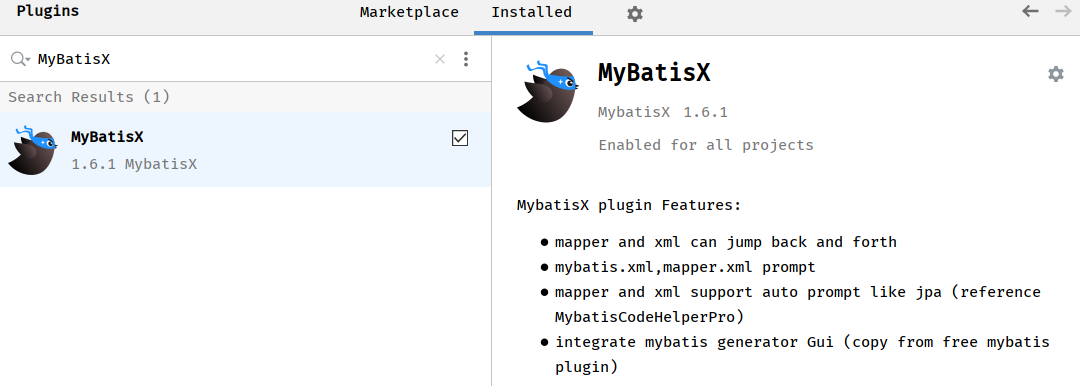
插件 为了方便开发我们可以安装插件MyBatisX
实体类 1 2 3 4 5 6 7 8 9 10 11 12 13 14 15 16 17 18 19 20 21 22 23 24 25 26 27 28 29 30 31 32 33 34 35 36 37 38 39 40 package cn.psvmc.zapicall.bean;public class UserModel private int id; private String name; private int age; private int sex; public int getId () return id; } public void setId (int id) this .id = id; } public String getName () return name; } public void setName (String name) this .name = name; } public int getAge () return age; } public void setAge (int age) this .age = age; } public int getSex () return sex; } public void setSex (int sex) this .sex = sex; } }
Service UserService.java
1 2 3 4 5 6 7 8 9 10 11 12 13 14 15 16 17 18 19 20 21 package cn.psvmc.zapicall.service;import cn.psvmc.zapicall.bean.UserModel;import cn.psvmc.zapicall.mapper.UserMapper;import org.springframework.beans.factory.annotation.Autowired;import org.springframework.stereotype.Service;import java.util.List;@Service public class UserService @Autowired (required = false ) private UserMapper userMapper; public List<UserModel> getUsers () return userMapper.selectAll(); } public UserModel findById (String id) return userMapper.findById(id); } }
Controller 1 2 3 4 5 6 7 8 9 10 11 12 13 14 15 16 17 18 19 20 21 22 23 24 25 26 27 package cn.psvmc.zapicall.controller;import cn.psvmc.zapicall.bean.UserModel;import cn.psvmc.zapicall.service.UserService;import org.springframework.beans.factory.annotation.Autowired;import org.springframework.web.bind.annotation.RequestMapping;import org.springframework.web.bind.annotation.RequestParam;import org.springframework.web.bind.annotation.RestController;import java.util.List;@RestController @RequestMapping ("/user" )public class UserController @Autowired private UserService service; @RequestMapping ("/list" ) public List<UserModel> getUsers () List<UserModel> list = service.getUsers(); return list; } @RequestMapping ("/userById" ) public UserModel userById (@RequestParam("id" ) String id) return service.findById(id); } }
日志打印 SQL执行打印日志
1 mybatis.configuration.log-impl=org.apache.ibatis.logging.stdout.StdOutImpl
设置日志格式
1 2 3 4 logging.pattern.console=%green([%d{yyyy-MM-dd HH:mm:ss.SSS}]) %cyan(%thread) %highlight(%-5level) %magenta(%logger{36}) %yellow(%L) - %gray(%msg%n) logging.pattern.file=%d{yyyy-MM-dd-HH:mm} [%thread] %-5level %logger- %msg%n logging.file.name=mylog.log logging.level.root=info
访问 启动项目,通过浏览器访问:
http://localhost:8080/user/list
http://localhost:8080/user/userById?id=6